EN

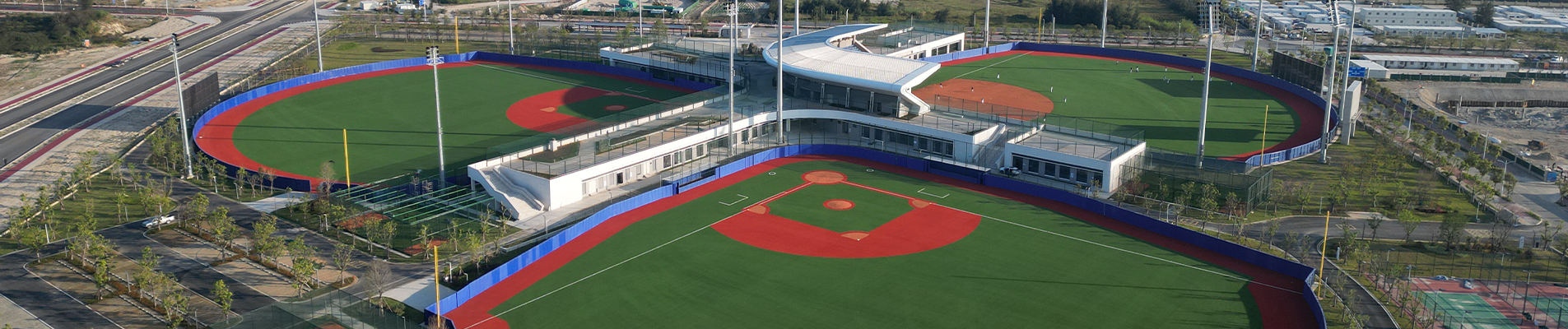
How to Select Sports‑Venue Materials: Artificial Turf & Plastic Running Tracks
Artificial turf has two main categories: infill‑type and non‑infill‑type.
Infill‑type: Grass fibres are supported by quartz sand and rubber granules. It represents a well‑established process with high cost‑performance.
Non‑infill‑type: Performance is built into the turf itself through specialised fibre processing. No quartz sand or rubber granules are needed.
The difference between the two options extends beyond one omitted construction step:
Infill‑type: Periodic replenishment of quartz sand and rubber granules is required over service life; granules are prone to loss; end‑of‑life recycling proves difficult.
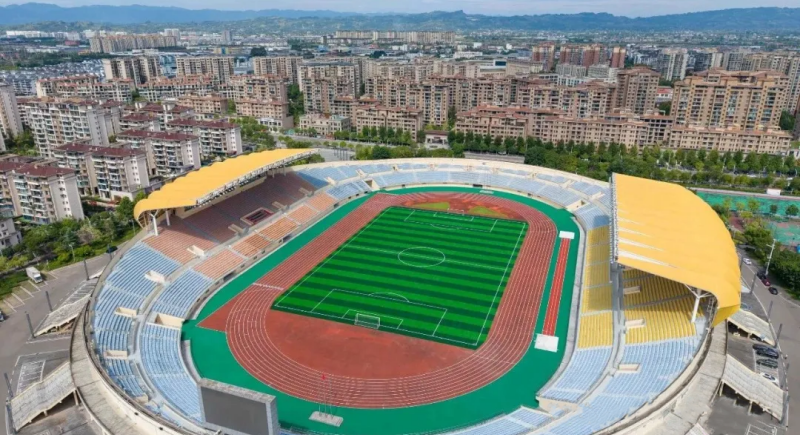
Non‑infill‑type: Low‑maintenance, granule‑free and usable right after installation. Take MCG “Beske” series as an example: its density reaches 5‑9 times that of ordinary turf, with total fibre content raised by 10‑12 times. The turf blanket is gap‑free. No shock‑absorbing underlay, quartz sand or rubber infill is necessary. It meets standards for international amateur competitions and professional training. Multiple MCG‑constructed non‑infill artificial‑turf football pitches have passed FIFA Basic venue‑quality testing, including the football pitch at Wenming Campus of Lujiang No.4 Middle School in Anhui Province, Shanghai Guangming Tianyuan Football Pitch and Liangping National Fitness Centre Football Pitch.
Selection Guidelines
Kindergartens & community venues: Prioritise non‑infill turf to eliminate risks of children accidentally ingesting loose granular infill.
Professional competition venues: Verify that key indicators such as shock absorption, vertical deformation, ball rebound and rotational resistance satisfy technical parameters for professional‑grade sites.
Five Types of Plastic Running Tracks
| Type | Structural Features | Application Scenarios |
| Permeable | Porous, breathable and water‑permeable | Most widely adopted for primary and secondary school playgrounds |
| Mixed‑type | IAAF‑recognised structure, commonly 13 mm thickness | Large‑and‑medium‑size athletics fields and competition venues |
| Composite | Multi‑layer installation with stable elasticity | Cost‑effective option |
| Prefabricated | Factory‑produced rolled panels, bonded on‑site | Professional athletics venues |
| Full‑solid | 100 % monolithic polyurethane construction | Universities and regions with large temperature fluctuations |
Permeable‑type: The preferred choice for primary and secondary schools. Test‑institution data show it accounts for roughly 63 % of school installations. It delivers economic costs, short construction cycles and convenient maintenance. Its breathability and water permeability minimise blister‑formation risks.
Mixed‑type / Composite‑type: Performance sits between full‑solid and permeable‑type tracks. Normally deployed for competition venues or well‑resourced schools. Higher investment is required compared with permeable‑type tracks, and stricter sub‑base standards apply.
Full‑solid / Prefabricated‑type: Outstanding performance for professional athletics venues, yet high in cost and rarely adopted by general schools.
For material compliance, track materials shall comply with national new standard GB36246‑2018; professional test reports for environmental‑performance indicators shall be available. Under normal operating conditions, the designed service life ranges from 8 to 10 years.
MCG Group is an integrated enterprise engaged in the design, R&D, production and sales of artificial turf, plastic running track and silicon‑PU materials. Production bases are located in Jiangsu and Chongqing, offering customised client solutions. Through years of development, innovation and accumulation, the “MCG” brand has secured its position as one of the major players in the sports‑venue materials industry.
If you have upcoming sports‑venue projects, leave a comment or send a private message with the keyword “sample” to receive product samples and quotation proposals.