EN
EN

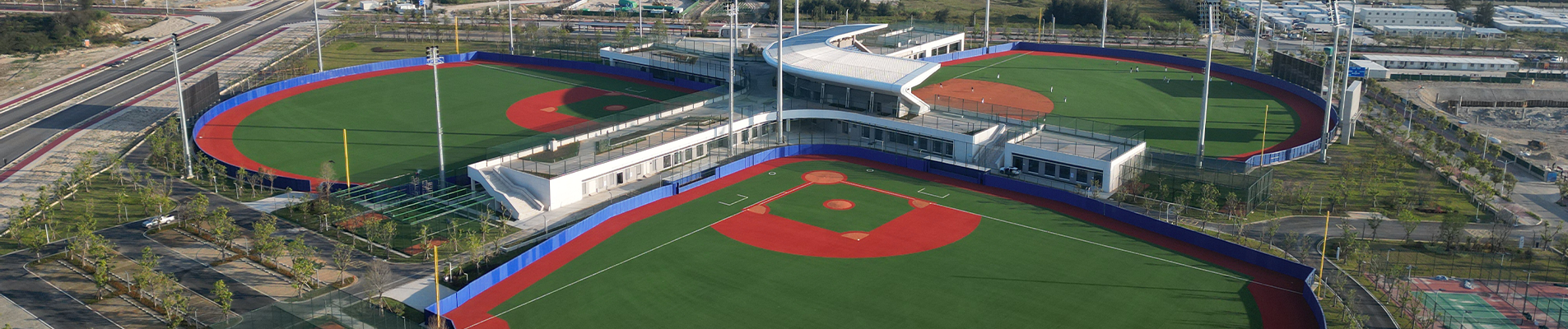
Sustainable Sports Surfacing: What Recycled Rubber, TPE and Low-Carbon Turf Mean for Your Next Project
Every now and then, a procurement conversation shifts. A few years ago, questions about a new sports surface were mostly about price per square meter and delivery windows. Lately, the first ten minutes of a tender call tend to be about where the materials come from, whether there is recycled content, and what happens to the surface at the end of its life. Suppliers who cannot answer those questions are quietly losing projects.
Below, the three material trends actually reshaping sports surfacing — recycled rubber, TPE and EPDM granules, low-carbon turf — then the questions worth putting to any supplier. To be clear up front: the observations are industry-level, not MCG test data; MCG's own specifications are issued on request.
Why sustainability is now a buying criterion in sports construction
Honestly, this was heading our way for years (industry trend). Sports surfaces sit in the public eye — schoolyards, stadiums, municipal parks — and they consume serious tonnage of polymer. Put the two together and you get regulation, procurement policy and public opinion converging on one question: can this be done with less footprint?
The most visible driver is regulatory: European end-of-life tyre (ELT) rules and circular-economy legislation keep steering recovered rubber toward new uses, and sports surfacing is one of the largest outlets for recycled granulate. Tender documents increasingly reference sustainability criteria, and owners feed the results into environmental reporting.
The quieter driver may matter most: life-cycle thinking. Buyers have learned the hard way that the first invoice is a fraction of the total cost. Materials choice dictates maintenance, replacement and end-of-life fate — so the materials conversation belongs in the specification, not in a post-contract chat.
Recycled rubber: giving end-of-life tyres a second life in sports surfaces
There is something quietly satisfying about recycled rubber granulate: a worn-out tyre ends its life as a running surface or play area rather than a landfill. It is one of the best-established circular materials in construction — mainly as infill in artificial turf and in shock-absorbing layers (industry practice).
In practice, though, "recycled" covers a wide spectrum, and the differences show up in performance. Pin these down with any supplier:
• Source and traceability. Where does the granulate come from, and how is it processed — deshredded, cleaned, graded? A vague answer usually means a vague material. Ask for documentation.
• Consistency. Grading, purity and cleanliness decide how the infill behaves and how evenly it settles over the first year.
• Performance evidence. Test reports should cover the finished system, not the granulate alone — a bag of pretty granules tells you little about ball behaviour.
Recycled content is a genuine win — but only when the supply chain is transparent about what is inside the bag.
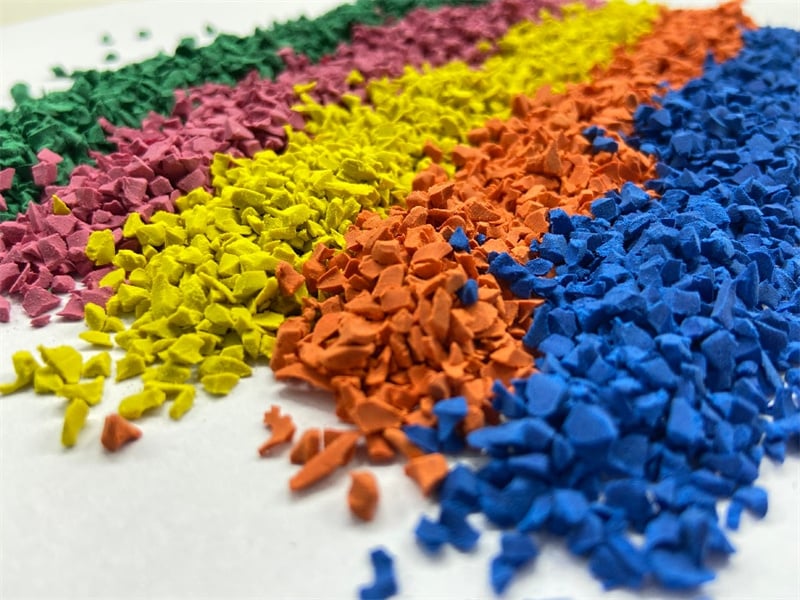
Colour-graded EPDM granules — recycled and virgin colour options (illustrative)
TPE and EPDM granules: virgin performance, controlled quality
Not every application suits recycled granulate, and it is worth saying so. TPE (thermoplastic elastomer) and EPDM (ethylene-propylene-diene) granules are the virgin-material route for demanding surfaces: consistent colour, low odour, weathering resistance, predictable performance — as infill, top layers, or within surfacing systems (industry practice).
To be fair, this is not a "green vs not green" argument — it is a trade-off:
• Recycled granulate — lower embodied impact and a mature supply chain, with performance that depends on feedstock consistency.
• Virgin TPE/EPDM — predictable performance and appearance, at a higher material cost.
• Blended approaches — recycled in the bulk layers, virgin where colour and surface quality are on display.
Where granules are manufactured in-house, quality is controlled from polymer to finished granule. MCG operates a dedicated rubber-plastic production base as one of its five production bases, producing TPE granules and EPDM rubber granules in-house, with a broader rubber products range.
Low-carbon and no-infill turf: cutting the materials footprint
The turf side is where the engineering moves fastest. The headline shift is no-infill (non-fill) turf: denser yarns now carry the ball behaviour and shock absorption that once came from tons of granular infill, so the infill disappears from the specification. Less material in the ground, no infill migration, a simpler story at end of life — no-fill is a growing category in the sport artificial grass market.
Alongside it, manufacturers are trimming polymer weight per square meter, trialling recycled or bio-based yarns, and stretching warranty periods. That last point is a sustainability strategy itself: a surface that lasts longer needs replacing less often. Hybrid systems — natural and synthetic yarn combined — offer another route to a lighter footprint.
That said, carry one caveat into any meeting: certification is a performance floor, not a sustainability badge. A surface can be FIFA Quality Programme-certified or EN 15312-compliant and still have an unremarkable environmental story. Ask for both — the performance certificate and the material story.
What to ask your supplier before you specify
Take this list into the next tender call — it reads like homework, but the answers separate serious manufacturers from resellers:
1. Where do the materials come from? Source, processing and traceability documentation on any recycled content.
2. Recycled or virgin — or both? What recycled-content percentage is available, and where can it be used without compromising performance?
3. What do the test reports cover? The finished system, ideally — not just the raw material.
4. Who actually manufactures the granules? In-house production (like MCG's rubber-plastic base) means controlled quality and stable supply; resold granules add an unknown.
5. What is the life-cycle story? Durability, maintenance, replacement intervals, end-of-life options — not just the first invoice.
6. Can the claims be documented? Material data sheets and certificates in writing. Verbal claims are not claims yet.
FAQ
Q: Is recycled rubber as good as virgin material for sports surfaces?
A: It depends on the application. Recycled granulate is proven in infill and shock-absorbing layers, but feedstock consistency varies; virgin TPE/EPDM offers more predictable colour and performance. Many projects blend both — recycled in bulk layers, virgin where surface quality matters. Ask for data-backed recommendations.
Q: What is no-infill turf and why is it considered more sustainable?
A: No-infill (non-fill) turf uses dense yarns to deliver ball behaviour and shock absorption without granular infill, cutting material use and eliminating infill migration over time. It is a growing category in sport artificial grass, highlighted for lower maintenance and a cleaner life-cycle story.
Q: Does MCG manufacture granules in-house?
A: Yes. MCG operates a dedicated rubber-plastic production base as one of its five production bases, producing TPE granules and EPDM rubber granules in-house. Specific recycled-content options and material data sheets are issued on request.
Q: How does MCG support sustainable projects?
A: As an integrated manufacturer-trader with 25 years in the industry, roughly 40,000 square meters of production area, more than 300 employees and annual exports over 3 million square meters of sports surfacing, MCG matches material options to your sustainability requirements, with installation and after-sales support.
Build your next sports surface around a defensible materials story
Sustainability has moved into the specification, and suppliers who treat it as an afterthought are the ones losing tenders. Define the recycled-content question, choose materials with documented performance, and verify manufacturing depth. Send MCG your project requirements and sustainability targets for a materials recommendation with the documentation.
Request a sustainable surfacing consultation · [email protected] · Learn more about MCG